
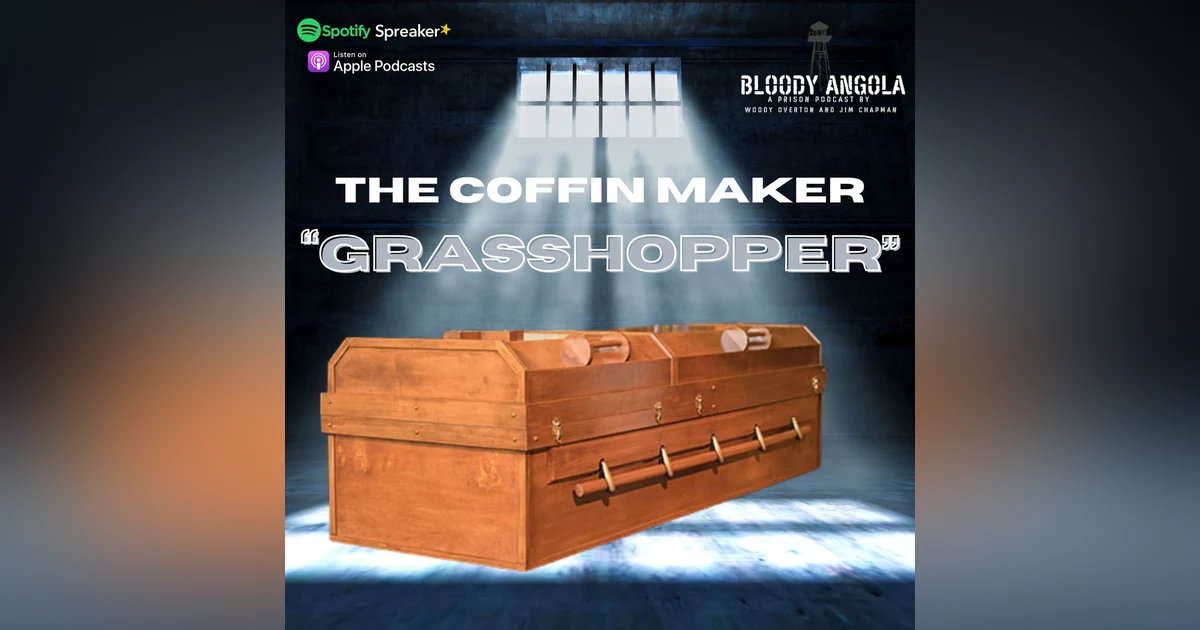
The Coffin Maker: Grasshopper


 Apple Podcasts

 Castro

 RSS Feed
In this episode of “Bloody Angola Podcast” Jim Chapman explores Lloyd Leggett's transformation from a 1971 murderer to a skilled coffin maker in Louisiana State Penitentiary at Angola.
Chapters
01:56 The Horrific Crime of Lloyd Leggett
02:31 Investigation and Arrests
10:18 Indictments and Sentencing
13:34 The Escape Attempt
18:04 Richard Leggett's Transformation
24:12 The Coffin Maker of Angola
31:13 Legacy
For Louisiana Local Advertising inquiries or to book appearances please email BloodyAngola@gmail.com
0:05 M M A Wall Street line, shackle change, Oh doesome girdy, it's calling my name. There is no mercy and it's been a tentery juice as the huge stream game Wrangle three. Come here be by me to die inside these walls, inside the wild and when the girls as I.
1:31 Hey everyone, and welcome back to Bloody Angola, a podcast one and forty two years in the making, the complete story of America's bloodiest prison. I'm Jim Chapman, and today I'm going to tell you about an inmate at Angola who really became famous for his good deeds while he was incarcerated at Angola and his amazing talent and wait until we get into that. But what Lani inside the wire was just a horrible crime. And he was an inmate who had the nickname at Angola Grasshopper. His name he was born with was Lloyd Leggott. Now, I did a lot of research on this one, and I came across some newspaper articles from his actual crime when they occurred, the manhunt for Lloyd Leggott and also the capture of not only Grasshopper but his accomplice, and all this occurred in the nineteen seventies, over fifty years ago. There's actually a pretty interesting attempted escape that we're going to get into.
2:41 So the way I'm going to do this one today is I'm going to reference those articles that I came across, and I'm going to kind of take you through time with this guy. And I promise you when we get to what he did with his life inside Angola, you're probably gonna be surprised like I was. And I'll start off by refer and seeing an article that was written in the News Digest, which was an a Meet City, Louisiana newspaper where this crime occurred in This article was dated March thirty first of nineteen seventy one, and the headline said Arcola couple shot to death last rites to be held today. A Tangibahoa parish man and his wife were shot to death during an apparent robbery Monday night in the grocery store they operated near Arcola. Sheriff Frank Edwards reported today Milton and Cora Davidson, both sixty two, were slain about six thirty pm in their store three miles from Arcola. The couple were found by a young man who came into the store shortly after the robbery slash murder. Davidson was found just behind the cash register, which was open and empty. Miss Davidson was found shot about five feet away from him at the end of the counter. Davidson, who was shot once in the head above the left eye, died some fifteen minutes after arriving
4:11 at Charity Hospital in Independence. Miss Davidson was pronounced dead on arrival at the hospital. She was shot just below the nose. Both victims were shot with a twenty two caliber gun. The bullets have been recovered and ballistics tests are being made on those bullets. There was no sign of a struggle. Technicians from the State Police crime Lab were dispatched to the scene to search for clues. Roadblocks were set up on highways in the area. Mister and Miss Davidson lived in rooms behind the grocery store. The bodies were at Mount Nebo Baptist Church at six pm Tuesday night, with services at the church at two pm Wednesday.
4:54 They were both natives of this area, So let me explain this were real quick a meet city Louisiana in the early seventies, very small town stuff like that just did not happen in that area, and these were elderly people, very well known in the community, entrepreneurs, store owners, so everybody that was in that area went to that store. They were just very well liked people and killed pretty brutally, shot in the face. And the police at this time did not have much to go on. All they had was spent shellcasings. And on April seventh of nineteen seventy one, there was sort of an update that came out on the Tangi Talk, which is another paper in that area, and it said investigation continues in Davidson Slang. Captain Charles Bender of the Tangibahoa Pairs Sheriff's Department said that the investigation was continuing into the slaying of mister and miss Milton Davidson, who were killed at their store on Our Cola Road. Mister Davidson lived for some fifteen minutes after being taken to the hospital and Miss Davidson was conscious when she was found.
6:08 Quote. We are continuing to track down leads and the investigation is pending. The couple was found shot to death at their store on Our Cola Road. Both had been shot with a twenty two caliber gun. They were found last Monday night about six point thirty pm by a young man who came into the store shortly after the shooting. He ran into the highway stopped a car to go for assistance after hearing Miss Davidson's call for help. Davidson, who was shot above the left eye, died about fifteen minutes after being taken to the hospital. Miss Davidson had been shot just below the nose. So at that point in time, they're investigating it, but they don't have a whole lot of leads that the public knows about. They apparently did have more leads than they were letting out, which is typical. And on April eighth of nineteen seventy one, two men from Kansas were actually charged with the murder of the Davidsons, and the News Digest had this article.
7:13 Two men from Kansas have been charged with the murder and robbery of mister and Miss Milton Davis, it was announced by Sheriff Frank Edwards Junior. A second robbery murder in kidnapping in Kansas led to the arrest April second of Richard Lee Leggett, nineteen of Newton, Kansas and Dwight Martin Kafka twenty nine of Hutchinson, Kansas. They are charged in Kansas with the slaying of James Leo Armer of Little River, Kansas, father of thirteen children, the robbery of the man he farmed four so apparently one of these guys worked for the guy they ended up robbing and the kidnapping of five members of the Wayne Ludstrom family.
8:00 Armer was slain with a twenty two caliber pistol. The Davidsons were both killed with the twenty two caliber at close range about six thirty five pm on March twenty ninth at their store. In About two hundred dollars was taken from the cash register. Since that time, Edwards had had his deputies working day and night on the case. He sent ballistic bullets all over the United States, and it was one of them which led the Kansas Bureau of Investigation to send bullets from the twenty twos in the possession of the accused pair to a meet ballistic experts at the Louisiana State Crime Lab and Battinary said the bullet from one of the guns was fired from the same one which killed the Davidsons. The other bullet recovered during the autopsy was so mishappened that further examination was necessary. Last week, Edwards and Captain Charles Binder went to Kansas to talk with the pair. They obtained signed statements from both which admitted to the Rcola slags. Wards and District Attorney Leonard Yoakum would call a special session of the grand jury to indict them, and that Tangibahoe Parish would begin extradition proceedings to return them to Louisiana to stand trial immediately after they are tried in Kansas.
9:17 Leggett and Kafka had left Kansas on March twenty seventh to go into the counterfeity business. Actually considered that a business in California, they said. In Austin, Texas. They headed east, going to Baton Rage, then back to a meet, and on to Arcola, where the killings took place. In Bugalusa, they stopped to get something to eat. They went east through Mississippi to Nashville, Tennessee, where they abandoned the car, a Blue nineteen sixty four Ford, before returning to Kansas on a bus. Leggott had been in reform school. He had been born at Fort Polk, but since the age of four had not been in Louisiana. He is six foot three and a half. Kaffa is six foot two and has never been to Louisiana before. On February fifteenth, he had been released from Kansas State Penitentiary after serving a sentence for burglary. So they have these two guys and again April twenty eighth, nineteen seventy one, they were charged end of getting these confessions, they get signed to confessions at that and on May twenty sixth, nineteen seventy one, the next update from the Tangi Talk and it says Kansas pair indicted in Tangibihoi slangs. Richard Lee Leggett and Dwight Kafka, both of Kansas, were indicted here Thursday by a Tangy Parish grand jury for the March twenty ninth murder of an Arcola couple. The accused pair was also indicted for the armed robbery of mister and Miss Milton
10:50 Davison at their rural grocery store. Leggott and Kafka are in jail in Lions, Kansas, where they are charged with a murderer in kidnapping. Attorney Leonard Yoakum said he is anticipating extradition papers. The Davidsons were found dead shortly after they were robbed. Sheriff Frank Edwards said in announcing the arrest of the pair last month that Leggett and Kafka have been traced to Kansas, into Texas, through Louisiana, and on to Tennessee before they both returned to Kansas. Both have signed statements related to the killing in tangebaho A Parish, so they get indicted, and on February fourth of nineteen seventy two, these guys got sentenced, and Morning World in Monroe brought this article. It says two Kansas men were each sentenced to double terms of life in prison here Thursday in the murder of an elderly or Cola couple at their grocery store. Last March, Richard Leggatt twenty of Newton, Kansas and Dwight Cafke twenty nine of Hutchinson, Kansas were given double life sentences plus thirty years in prison for armed robbery of mister and Miss Milton Davidson. Last October, Leggatt and Cafke pleaded innocent by reason of insanity under state law, a person is allowed to please a sanity.
12:14 Hearing was held for them Thursday in State District Court. Three physicians testified, and Judge Grover Covington ruled the pair, saying Legat and Cafke then consulted with their lawyers and changed their pleas to guilty to the armed robbery and guilty without capital punishment to the murder. So they cut a deal there. They said, hey, we're not going to execute you if you plead guilty. They also waived delay in sentencing. The judge ruled the sentences or to be served concurrently with any sentences previously imposed. This means the two men will be returned to Kansas, where they had been sentenced in the death of a Little River, Kansas man.
12:55 He was killed less than a week after the Davidsons were shot to death. On March twenty ninth, nineteen seventy one, Leggott was convicted and sentenced in the Little River incident to fifteen years to life and five years to life on several kidnapp charges. CAFKEI had been sentenced to life in prison. If pardoned or paroled, they must return to Louisiana to serve any remaining time in the Davidson deaths. So at that point they have to go to Kansas. And this is where it gets really muddy, because judging by what I read in that article, I'm thinking they're screwed. They're in Kansas for the rest of their life. But Legott did make his way to end Gola shortly after.
13:40 The trail just kind of falls off as to why, but I'll tell you. On October eleventh, off nineteen seventy eight, an article was put out by the Miami Herald, and it tells a story of an escape attempt or an accused escape attempt by Richard Leggett. And I'm just going to read you this article. It says he would there the whole time. So since he never had escaped, it was difficult for Richard Leggett to explain the escape conviction on his criminal record. The Louisiana Supreme Court has rectified the situation, reversing Leggott's escape conviction by ruling there was no evidence he left Angola State Penitentiary. Leggott failed to show up for his work assignment one morning in nineteen seventy seven, and after a day long search, was found curled up with a novel and lying on a pillow inside a conveyor machine in the prison cannery. Leggott eventually was indicted and convicted of simple escape. He was sentenced to an extra four years in jail. In the five to two decision, the court said Legott might be subject to prison discipline rules for the episode, but nothing more so.
14:52 He appealed an accusation of escape in his I guess point there, what it sounds like to me was he technically never escaped. He was on in Goola property the whole time. And then I dug a little deeper. I came across an appeal that the state had issued, and I'm just going to read that to you. It says defendant was legally committed to the State Penitentiary at Angola on February third, nineteen seventy two. He was assigned to a dormitory in the Medium Security Complex area. In addition, defendant was assigned to the work in the prison's tag plant making license plate shall. The record also reflects that the prior start of the workday, inmates have the option to leave the dormitory, go to the kitchen area for breakfast, or remain in the dormitory, whether they remain in the dormitory or depart for breakfast. Inmates are required to report to their job assignment no later than eight o'clock am.
15:51 The inmates, whether in the dormitory, kitchen area, or at their work assignment or the responsibility of the prison officer assigned to the particular area or building. The inmates may be excused from any of their work assignments or assigned areas on various quote callouts example attorney callouts, hospital callouts, visits, education callouts, and classification callouts. We note also that inmates walked from area to area along a fence to walkway unescorted by guards. The officer in charge of the defendant's dormitory, John Frank, testified he saw the defendant in the dormitory at approximately seven thirty am on April sixth of nineteen seventy seven. He stated that at seven fifty five am he received a call from Edward Thomas, the prison officer assigned to the tag plan. He stated that Leggott had not reported for work at the plant. A search for the defendant in the dorm was made without success. A prison chase cruise subsequently located Leggott hiding in the conveyor machine at the prison cannery at approximately five pm. The defendant was found inside the machine, lying down on his back with his hands resting on his stomach. He had a pillow or something in the form of a pillow under his head. He even had a pocket novel to read.
17:11 It was noticed that the defendant had apparently taken two pieces of cardboard and placed them on both sides of the conveyor machine so he could not be observed inside the machine. Upon discovery, the defendant neither struggled nor attempted to get away from the search crew. He had not broken or damaged anything while hiding in the canery building. The prison cannery is located approximately two hundred and fifty to three hundred yards from the tagplant, the defendant's assigned place of work, so apparently that's how he tried to escape. Surprisingly, the Supreme Court kind of ruled in Leggett's favor on that and said, technically he never escaped the prison. He attempted to escape, but he never escaped. Just interesting and kind of bizarre. And then again things kind of fall off for Leggott. Apparently he was mining his manners in prison, and then in two thousand and five an article comes out. Now, I want you to remember, Leggott went to prison at twenty years old, so even in two thousand and five, he's not that damn old. But a really interesting article comes out in two thousand and five. It's by Gary Fields of the Wall Street Journal, and it says, at the Angola State Penitentiary, here Richard Leggett, a yellow pencil tucked behind his right ear, put the molding on his latest creation, a seven foot coffin. He worked with submergency, sewing and stapling the white bedding inside. He always likes
18:41 to keep three coffins in stock so he doesn't run out half a mile away. One of the other handmade caskets, birch and pine stained in rich blue, were being laid in the ground at the prison cemetery. It held the body of a fifty seven year old fellow inmate in prison since the seventies for killing a thirteen year old girl. As the prison's coffin maker, mister Leggett, fifty three years old, has been busy. The prison has needed one or two of his caskets in each of the last five weeks. At Angola, ninety seven percent of the inmates now die in prison. The rise of lengthy mandatory sentences in nationwide tough on crime attitude has resulted in a booming prison population two point one million last June. And then it goes through stats on that that are not important. Inmates often arrive at prison in the physical condition of someone ten to fifteen years older because the lack of healthcare, and it goes through that, again not important. At Angola, funerals are elaborate affairs, with handmade coffins pulled to graves by horse drawn carriages, and rights conducted almost entirely by inmates.
19:53 Wardenborough Came believes such services are stabilizing influence, keeping inmates busy in all offering purpose to those who have no hope of leaving alive. Quote A man wants to be productive, even the ones here, the warden said. Once known as the bloodiest prison in America, inmates at Angola used to fashion weapons from inconspicuous items such as toothbrushes or towels to maim and kill a murderer. Moth was considered normal today, though it isn't the Angola of quote dead man walking or Monster's Ball two movies film here. Now it's an older Angola and death comes typically from natural causes. Last year, twenty inmates at Angola died of natural causes. This year, twenty three have died already, none of them from inmate on inmate violence. The prison lost its oldest inmate earlier this year, a ninety five year old who have been in and out of prison since Harry Truman was present in During the last decade, there have only been four prison murders at Angola. Some inmates attribute that to what they call quote criminal menopause, meaning when they hit a certain age, their violent nature dissipates. They also credit the warden, a former teacher, who said it came to correction because high school students were too unruly to deal with its aging population over five hundred inmates, and then Gola had been trained to perform CPR. There's a hospice here for those who are making final stages of terminal illnesses, and
21:26 Warden Kane has created a funeral industry, of which mister Leggott's coughing kaboom coffin making is a primary piece. Other inmates make shrouds for the caskets. And planned services, and Gola gets society's most serious offenders, child molesters, murderers, and rapists. Two years ago, the prison stopped accepting anyone with the sentence of less than fifty years, meaning few will ever leave. Quote. A couple of decades after I got here, people actually got out. We used to have a call out every word day, where three or four would be called out they were going home. This from Douglas Dennis, sixty nine, who arrived here in nineteen fifty seven and is serving a double life sentence for killing two prisoners in fights.
22:10 Is now a writer for The Ngolite, an award winning publication whose death listings are scoured by the inmates. Now quote they might as well have welded the doors shut. About half of those who died Inngola are buried in the prison's grounds because inmates have lost touch with their families and have no one to collect the remains. Even your bones don't get a second chance to get out, said mister Dennis, the prison's unofficial historian. The Mississippi River forms three of the institution's four borders, and Tunica Hills, an area of snakes, trees and wild animals, is fourth established as a prison in eighteen eighty and Gola gets its nickname from the plantation that preceded it, which in turn was named for the area of Africa where most of its slaves have come from. Except for the occasional vehicle, there is no mechanical noise. During the day, groups of inmates carrying hoes, shovels, and sling blades head to the fields where they grow four million pounds of produce ranging from corn to wheat each year. At night, only lights from various cells on the eighteen thousand acre compound dot the darkness. The prison grounds are larger than the island of Manhattan, and you've heard that many times. When there are violent incidents and attempted escapes, they are dealt with swiftly.
23:30 Officers are put into cell Block J, where they remain in six by eight cells twenty three hours a day for a minimum of six months. They aren't allowed to make telephone calls, smoke, or have visitors. Quote at Angola, life means life, said Warden Caane sixty two, the short, white haired warden who occasionally rides his Harley Davidson down the twenty mile asphalt highway that dead ends the prison gates. He have mixed feelings about his elderly inmates. Quote. Prison shouldn't be a play for dying old men. It should be a place for predators. For years, inmates were buried in flimsy coffins that resembled shipping crates, each costing between six hundred and fifty dollars to nine hundred dollars. In June of nineteen ninety five, the prison was preparing to bury Joseph Siegel, a sixty nine year old prisoner who had been convicted in nineteen seventy one for burglary and murdering a state senator. As the inmates lifted mister Siegal's coffin to lay into the freshly dug grave, his body fell through the bottom of the casket. They carefully laid the coffin over the body and started to shovel dirt over the coffin. The lead then caved in. Warden Kane, then only in his first year on the job, was disgusted. Quote.
24:49 Once a man dies, his sentences complete, and there should be dignity in passing, he said. He asked some inmates, including Eugene RedWine, who had committed the murder with mister Siegel, and was known for his carpentry skills. Whether they could build a coffin. The inmates agreed, making a coffin in two weeks at a cost of two hundred and fifty dollars, considerably less than the prison had been paying in much higher quality. Mister Leggett, now the principal coffin maker here, has only been to one funeral in his thirty four years at Angola. It was after the March two thousand and three death of his mentor and predecessor, mister RedWine. He sat on the front row in the chapel inside the hospice, the area reserved for family. There was no one else there for the seventy four year old man.
25:36 Mister Leggott said his mentor taught him the importance of doing his job well. He said, quote, give it your best effort. If you're going to do something, give it your best. He instilled that in me. The two met after mister Leggett, who came to the prison as a virtual teenager, had been in the two man sale for six years. Mister RedWine, nearly twice mister Leggott's age, started teaching the younger made about carpentry. Mister Leggott took to it and began reading everything he could. The two became skilled carpenters, making furniture, rocking, chairs, and toys, most of which went to the staff. Now there's little mister Leggott can't make. All he needs is a picture or a drawing. Cabinets, dressers, and potato bens are all in his repertoire. Most items are used at the prison, and a few years old, he earns the prison's top wage, twenty cents an hour, giving him spending money for incidentals. He enjoys admiring his finished products, especially the coffins. If you'd seen what they were buried in before, you'd understand, he said. Nicknamed Grasshopper in his early days here because he was skinny with long limbs, he killed a man and a woman on May twenty ninth, nineteen seventy one, near a meat Louisiana as he robbed their store. When asked how he remembers the exact date, he spits tobacco juice on the ground and replies, why would I remember it? That's something that weighs on your mind. I have a lot of regrets
27:07 today mister Leggott is a heavy set man with thick glasses, a bad heart valve, and diabetes. Because he's an inmate trustee, which means he's a low risk for behavior violations, he isn't under constant guard and lives with the other trustees in a cell block reserved for them. A liner, mister Leggott spends most of his time in the carpentry shop, working with two assistants, meticulously going over every detail. You never can tell, he said, standing near one of the oblong boxes, when one of them is gonna be yours. This month, mister Leggott had to increase his work schedule. Two inmates died in another committed suicide in a five day period. All were buried in the prison cemetery. Cleaning out his entire stock of caskets for the funeral Richard Sedgwick Heart, the man who killed a thirteen year old girl.
28:00 Inmates gathered at the prison park. They followed the prison's hearse, a black horse drawn carriage built by inmates in nineteen ninety eight to resemble hearses used in the eighteen hundreds. Diamond and Lightie a pair of white twenty two hundred pound per chairing horses, descendants of the warden's own champion per Cherrion pulled the carriage on to the road of the cemetery with little urging from coachman Lloyd Bone's Bone. Mister Bone, a gaunt, unsmiling man with hallow cheeks, had been here since nineteen seventy one when he stabbed a man during a knife fight in Algiers, one of the toughest sections of New Orleans. The loser died, the winter got life and in Golan. Of course, I told you all about Bone just last week. A few years ago, Warden Kane asked mister Bone, who helped tend the horses at the prison stable, to drive the horse. The job stuck, The warden bought him a tuxedo in a top hat and named him Doctor Death. Sending Ramrod straight at the hearse, mister Bone said he never looked back at the carriage, but ads, I'll never forget what I'm caring. At sixty four, he frequently thinks about what his own ride will be like.
29:11 Who's going to drive the hearse when my time comes? Mister Sedgelhart had no family at the funeral service. His mother died a month before and he did not have anyone to claim him. Four dozen inmates who knew the deceased walt behind the hearst to Point Lookout two. The prison cemetery opened that in nineteen ninety six. There have been ninety seven funerals here in nine years. Its predecessor, Point Lookout one, a short distance away, has three hundred and thirty two marked graves and an unknown number of unmarked ones. Officials stopped using it when they began digging a new grave and discovered human bones were already there.
29:52 Since April, funerals have been so frequent that the ground hasn't settled enough on ten graves to add the simple white crossy used to mark burial plots. The inmates sing amazing Grace along with the clamping of the horse hooks. All of them had been in Angola at least ten years, most for much longer. Every detail of the service, from the hand dug grave to the briting of the horse tales was done by the inmates with an extension program from the New Orleans Baptist Theological Seminary. They are ample inmate ministers to conduct the funeral. They quoted scriptures saying hymns without bibles or notes. At the cemetery, three inmates asked an assistant warden if they could request that their families bury them there one day. One by one, the inmates walked to the casket, touched it and looked at pictures of mister Sedgirick art on top. At the gravesite, the inmates sing acappella, I'm free, Praise the Lord. I'm free, no longer bound, no chains holding me, My soul is resting.
30:53 It's just a blessing. Praise the Lord, I Elijah, I'm free. Very well written article, and what we found out there was this insane talent that Richard Leggett possessed and also the highest paid inmate at the prison twenty cents an hour, highest paid inmate. And then the next time mister Leggott appears in the news was twenty eighteen, some thirteen years after the article I just reference came out and cruxnow dot com put out an article and it was discussing Billy Graham and the casket he was laid to rest in.
31:35 And I'll move to the aspect of the article that is critical to our story today. It says, in nineteen seventy seven, Chuck Colson, an evangelical Christian who had served prison time for obstruction of justice in the Watergate scandal and who would become a national prison minister, visiting Angola with Tex Reardon, who was associated with Graham and his worldwide evangelical crusade. Quote in the nineteen fifties, my mother would send a check of five dollars every month to Billy Graham, even though she was a school teacher and my parents were poor. So I asked text Rid and if there was any way he could get Billy Graham to come here because the prison needed him. And he's referencing Angola. Not long after that, grandson Franklin visited Angola and was so impressed that he set the wheels in motion for the construction of two more chapels, one for the inmates and another for the employees of our little city.
32:31 Cain was quoted as saying they wanted their own people to come build it because it was a ministry for them. Caine said they wanted the pews to be just old timey, so it would look like an old timey church. And he's referencing that the prisoners wanted to build it. They put an old bell in the top of the imposing steeple. The bell came from a locomotive that holds sugar cane around the eighteen thousand acre Angola plantation in the late eighteen hundreds before it became a prison that was larger than the Island of Manhattan. The Grahams wanted the steeple to be tall enough so you could see the church from death row. Caine said, during one of Franklin Graham's visits to Angola, he walked into the prison museum and saw an inmate made casket. He was overwhelmed by the beauty and simplicity of the treated plywood. The white betting for the inside of the coffins came from Walmart Morgan.
33:25 Kine said, quote, he told me this is one my dad would want to be buried in. It's so plain, but it's built by prisoners. We got to have these, Caine said. Franklin Graham ordered six coffins, including one for his father and his wife, Ruth, who died in two thousand and seven. Three inmates, Richard Grasshopper, Leggett Clarence Quote, mister Bud Wilkerson, and David Bacon had the special assignment. Of the three, only Bacon is still alive. He was paroled in December of twenty twelve. Quote. They would pray before they started every day and asked that God would anoint their work, because this was a very serious thing to them. Caine said, Billy Graham was a human. He wasn't God, but he was one of the godliest humans on earth. They took it very seriously and it was a reverent operation. At Franklin Graham's request, the three inmates would burn their names into the outside of each casket.
34:24 Graham was laid to rest on March second. In that end Goola Coffin after lying for two days in the US capital Rotunda. Cain said, the convergence of sacred circumstances, how Graham and faith brought peace to Angla, and how Inngola brought peace to the Graham family leaves him a most speechless. Quote. If my mother in Heaven knows what's going on down here, she would be proud because she wrote those little five dollars checks. It influenced her son to like Billy Graham. Kine said, she led me in that direction. While because of ill health, Graham never could visit Angola came send him a key to one of Ngola's oldest cells. A few years ago, Kane traveled to the mountains of North Carolina to offer his thanks for all that Graham and his son and made possible at Angola.
35:15 Quote. I got to spend the afternoon with him, and he said, I pray for you every day, and my nurse can verified. And then he took out the key and he said, every day I have a devotional and I hold the key you gave me in my hand, and I pray for you, and I pray for your prison. No wonder we were successful. Cain said, So how about that this guy and you can never take away from the crime he committed brutally killing two elderly people, shooting them in the face. But even in prison, he ended up not only finding a talent and putting it to good use, making all these coffins for prison inmates, becoming really probably the best ever in carpentry at Angola, the highest paid prisoner in Angola, but also made a coffin for And I would agree with this. One of the most godliest humans, if not the godliest human of all time. In the Reverend Billy Graham unbelievable. And as I mentioned in that article, Richard Leggott did pass away. He was fifty five years old.
36:33 He passed away in two thousand and seven, and I'll read you just his short obituary. It says Richard Lee Leggett, fifty five passed away Wednesday, March twenty first of two thousand and seven after a long illness. Services were held at Miller Funeral Home on Saturday, March twenty fourth. Richard, or quote Grasshopper, as he was known by his many friends. Everyone worked with wood and leather most of his life. His hand crafted works would be cherished by many people. Survivors include two brothers, John of Wichita, Kansas and Bill of Newton, Kansas, one sister, Joyce of El Dorado, and one grandson, Chris Lee. He is survived by several nieces and nephews and lou Flowers. Donations may be made to the Richard Lee Leggett Memorial Fund care of the Hospice Program in Gola, Louisiana. So there you have it. I just find that to be very interesting A story I came across as I was working on the story that I told you last week about Bones, So if you haven't heard that one yet, check it out. Thank you so much for listening. Check out the Patreon for commercial, free early releases, and until next time, I'm Jim Chapman for Bloody Angla, a podcast one hundred and forty two years in the making, the complete story of America's bloodiest present peace.
38:19 A Wall Street line, Shackle Chaine, Oh gluesome girdie, it's calling my name. There is no mercy and this being a tentery juice as the huge stream game Wrangle three. I'm here by me to die inside these walls, inside the wild. And when the walks, I'm know it's overbody Angler, ohbody Angle.