
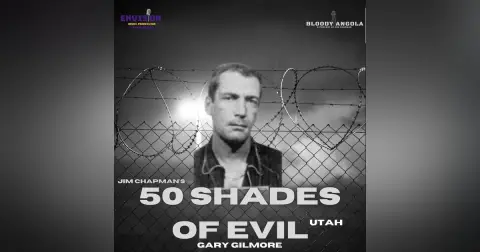
50 Shades of Evil: Utah - Gary Gilmore


 Apple Podcasts

 Castro

 RSS Feed
Timestamps:
04:58 A Family Built on Lies and Violence
11:12 Prison Becomes Gary’s Home
18:40 Two Young Fathers, Two Brutal Robberies
24:30 Conviction—and a Death Sentence
29:06 A Mother, the ACLU, and the Battle
31:26 A Failed Suicide Pact and a Hunger Strike
33:11 Gilmore’s Final Night and Firing Squad Execution
Join Bloody Angola on Patreon for Commercial Free Early Releases and more here: www.patreon.com/bloodyangolapodcast
For Louisiana Local Advertising inquiries or to book appearances please email BloodyAngola@gmail.com
0:15 I walk a straight line, shackled chain. Oh, gruesome Gertie is calling my name. There is no mercy in this penitentiary. Just ask the hill string gang, a wrangle of three. I'm here for to die. Inside these. Walls inside the. Wild and when the wolf cries Hey y'all, welcome back to Bloody Angola. I'm Jim Chapman and this week we're opening a brand new state in our 50 Shades of Evil series because each week with the series I'm bringing you one of the most dangerous inmates in each of
1:46 the 50 states. Today makes number 25 and today's state is Utah and I'm going to tell you the story of Gary Gilmore. Now here's the whole thing In miniature, if you will, before we go back to the beginning. Because I want you to know why this one is different from every other man or woman that we've covered so far. Gary Gilmore murdered two young fathers on two consecutive nights in July of 1976 for $ 150 and $ 125. And then he did something no American can. had ever done before that we've covered. He demanded the state of Utah execute him for it. He fought his own mother and the ACLU all the way up to the Supreme Court to make it happen. And he won. Today we're going to do what we always do. We start at the beginning. And Gary Gilmore was born on December the 4th of 1940 in McKamey, Texas. Now, McKamey, Texas is a little oil town. It's in the western part of the state. It's really the kind of place a man passes through or hangs out in when he doesn't want to be found, right? And the very first document of this boy's life, his birth certificate, the first piece of paper with his name on it was wrong. The name on the certificate is Fay Jones. Robert Kaufman. Now, Fay is his grandmother's name. Kaufman is nobody's name. Not really.
3:18 Kaufman is just the name his father was living under in Texas because his father, Frank Gilmore, was a con man, an alcoholic who would feed his family selling magazine subscriptions that did not exist. And this was the early 50s, y'all. So it wasn't like today where you could go online and order magazines or hell, they don't even have magazines hardly anymore. But this was a time where there was no due diligence, if you will, on if someone was legit or not. And his father, Frank Gilmore, was someone that was just going door to door and telling people, I'm going to sell you Sports Illustrated. They would give him 12 bucks and they'd never see him again. is actually a pretty lucrative scheme for him. But it tells you that the start of his life was a total lie, right?
4:09 His mother, now she would fix the name soon enough. She's going to call her son Gary Mark Gilmore, and that's the name the world would come to know. But the piece of paper, that birth certificate, it did survive. As grandmother Faye kept that original certificate, and roughly two decades later, a young man already deep in trouble would find it, read it, and conclude that he must be illegitimate. Someone else's son entirely illegitimate. And he would carry that belief for the rest of his life. Now, I do want you to picture that, a boy deciding who he is from a document, not from love, not from family, from a piece of paper. And the paper told him, He was a mistake with the wrong name. Now, there's a second piece of this family mythology, if you will, that hung over that house. And I'm going to give it to you straight because the brother who wrote it down believes it's not even true. The story goes like this.
5:12 Frank Gilmore's mother, Faye, once told Bessie that Frank's father, Gary's grandfather, was was a famous magician who had passed through Sacramento. Now, Bessie, Gary Gilmore's mother, she loved a mystery. She went and she researched it at the library, and she concludes the magician that was passing through was Harry Houdini, the same Harry Houdini who is the greatest escape artist to ever live, right? Now, here's the problem. One of Gary Gilmore's brother actually tells this story in a book And he said that Houdini, who was 16 years old in 1890, the year that Frank was born, had not even taken up magic yet. So the story doesn't hold water. McKell, the brother who wrote the book, his position is it's all bullshit. But both of the parents of Gary Gilmore believe this. So what was that house actually like? And I want to be careful with you, and I will be.
6:15 What follows actually comes from Mikkel Gilmore, who is the youngest of the four boys that wrote that book, which is one man's memory of his parents and his brothers. It's not sworn testimony, but it's really the only account we have to refer to. Now, Mikkel doesn't write it like a man settling scores. He writes it as if he's trying to understand how his family produced a murderer and nearly produced more than one. Now, per his book, the family drifted across the West on this subscription scam money, town to town, scheme to scheme. And Frank was always one step ahead of the consequences. Frank, per the family account, had other wives and other families somewhere behind him, none of whom he supported, and he married Frank. Bessie, who was a Mormon girl from Provol, Utah, who had been outcast from her own family because she didn't follow the faith, if you will, of Mormons. Now, his dad, very violent guy, Frank Beat, his three older brothers, Frank Jr., Gary, and Galen with a whip and a belt or whatever else was around that house for little to no reason. And he would also beat Bessie from time to time. So he had a pretty hard childhood. But I want to make this clear. It's not an excuse for what he did.
7:44 It's just important that I tell you the full story. And that's why I'm doing that. Now, for all of these problems, Gary Gilmore was not dumb by any means. As a matter of fact, he had his IQ tested and it tested at 133, y'all. He posted high aptitude scores, high achievement scores. He showed real potential. Teachers also noticed he was a good artist. He could paint just about anything and draw just about anything. But even with all that talent and all those big brains, he drops out of school in the ninth grade. Now, nobody in this story can say the boy had no other way out. He had his mind. He had the talent. What he did not have was a house that kind of nurtured that.
8:30 So this gifted boy with the artist's hands, he made his choice early in life, and that was a life of crime, and specifically as it related to cars. By 14 years old, he was already arrested after being caught running a small car theft ring with his friends in Portland. Now, when he was arrested for that, it's the 1950s. They don't keep 14-year-old boys in jail in those days. And so they called his father. They released him with a warning to his father, thinking his father was going to take care of that from there. But Gary didn't learn. Two weeks later, he is back in court on another car theft. All of this at just 14 years old. Now, this time, the court actually sends him away to the McLaren School for Boys and in Woodburn, Oregon. He gets released from McLaren School for Boys the following year, and if you're waiting for me to say he was reformed and everything went on great after that, the reform school did not reform him. What that school actually taught Gary Gilmore is the lesson every institution would treat him for the next 20 years. How to do time, how to read a room full of men, how the inside world works, its currencies, It's hierarchies. It's patience. The straight world for him got him a year of school he didn't even stay in. The inside world... got him for good one
10:01 commitment at a time and in 1960 he's back this time at the Oregon State Correctional Institution on another car theft charge And he was released later that year. And then the record gives us a scene that tells you everything about what is happening inside of this young man. In 1961 and 1962, Frank Gilmore, the con man, he's diagnosed with terminal lung cancer. And at the end of July, 1962, Frank actually dies. And Gary, who from all accounts hated his father, he was actually in jail during this time. But the jailer actually goes to Gary and says, hey, man, your father died. And what does he do? He tries to commit suicide. He actually slices his wrist in jail.
10:52 And this would become something that was reoccurring for him. He actually would have four suicide attempts over his time in prison. But it started when he was 21 years old, 14 years before he would become well-known and those suicide attempts would become more famous. Now, two years later, the revolving door stopped for Gary Gilmore because in 1964, he's actually arrested, jailed, and convicted for assault and armed robbery. And he gets a 15-year sentence as a habitual offender. And he is sentenced to the Oregon State Penitentiary in Salem.
11:34 15 years, and he's 23 years old at this time. Now, a prison psychiatrist also at this time gives him a diagnosis that would follow him in one variation or another for the rest of his life. Antisocial personality disorder with intermittent psychosis decomposition. And I want to translate that for you out of the clinical language. Maybe it'll make it easier for you to understand across his life. The psychiatrists who examined Gary, and there would be many, including four separate ones in 1976, they all landed in the same place. Antisocial personality disorder that was aggravated by alcohol and drugs. Basically, he's a man who doesn't feel what other men feel, who cannot be reached by consequences of his action. But he was legally sane. He was aware of what he was doing. He was aware that it was wrong. And I want you to remember that because that diagnosis is going to play a part later on. Now, prison becomes Gary's hometown. I'm not using that as a metaphor. From his mid-teens to the age of 35, he spent the overwhelming majority of his life locked up. Reform schools, county jails, whatever.
12:53 The free world was really the place he just visited. The cell is the place he called home. And inside, he's not a model prisoner just quietly doing his time like a normal convict. He's violent inside. He fights a lot. And he starts accumulating an institutional record that would become very concerning. So in 1972... he actually miraculously gets parole. But his release was conditional. He would have to spend weekdays in a halfway house in Eugene, Oregon, and he would have to start studying art at a community college.
13:34 And guess what? He never registers for the classes. Within a month, he's arrested and convicted of armed robbery again, just a month later. So he goes back to prison. Now, in 1975, he was no less violent than he was in his first stint. And Oregon actually transfers him to the United States Penitentiary at Marion. And y'all, that prison is a serious maximum security prison. It was actually built because Alcatraz closed and it was built to replace Alcatraz. So he goes to Marion. And he is there until he is 35 years old, and he actually gets parole again.
14:23 So let's go to 1976, Provo, Utah. And this place, y'all, is as far away from who Gary Gilmore is as a person as you can possibly be. It's a very clean, church-going college town. It's in the shadows of some mountains, and it's home to BYU, Brigham Young University, which... is a very popular university in Utah. So in April of 1976, walks in this 35-year-old ex-convict, and the only reason he's even hanging out there is because that's where his mother comes from. And he had some family up there. As a matter of fact, he had a cousin named Brenda, and Brenda agrees to sponsor him during that parole. What does that mean? She's going to let him live inside her house, and she'll be kind of the responsible person party for him. Now this is a distant cousin. This is not someone who necessarily knew Gary very well. She was a working woman in Provo and she puts her name on a piece of paper to let Gary Gilmore out of the federal system. Now she does her best to help him. She tries to find him work and his uncle, a guy by the name of Fern D'Amico, who is actually his mother's brother, gives him a job at a shoe repair shop. And then Gary goes to work at an insulation company owned by a man named Spencer McGrath. Now, for a few weeks, the record shows him kind of what appears to be getting straight in
15:55 life and shaping up to be maybe a contributing citizen. He had a job, a roof over his head, and it seems like he had some of his family support. Within weeks, his old pattern changes. starts to come back. He's stealing, he's drinking, he's fighting. In the whole plan of his release on parole, the cousin that was helping him out, working at his uncle's shop, all of that starts coming apart in Gary Gilmore's hands almost immediately. Three months out of prison, he becomes broke, he's drinking, and he is sliding. And into that slide, at the worst possible moment, walks a 19-year-old girl. And her name is Nicole Barrett. Now, let me give you her facts because this young woman is going to be turned into a character by books and movies over the next 50 years.
16:51 She deserved to enter this story as a person. And I want to tell you who she is. At this point, she was 19 years old when she met Gary Gilmore in the spring of 1976. Now, even though she was young, she had already been married twice. There are various accounts about that. Some describe her as a widow. Some as a divorcee. But what we do know as a fact is she was married twice. She had two young children, two babies, a teenage mother, two marriages behind her. When this 35-year-old ex-convict, three months out of Marion prison, walks into her life. Now, the relationship started off casual, but it didn't stay casual. It turned pretty intense. Then it turned strained the way everything in Gary Gilmore's life He would be aggressive toward her and her family. They would press her to end the relationship because they can see that what she's standing next to, even if she can't, is an absolute bad idea. Now, there was a book written by Norman Mailer later on about all of this, and he compiled this book from hundreds of interviews. And it also became a version in a movie that was released later on. He would talk about Gary hitting her and Nicole breaking off the entire relationship. And in July of 1976, this poor girl was so scared, she actually
18:22 goes into hiding with her children. By July of 1976, everything is gone. His girlfriend, money, hope, whatever. And he's already a raging alcoholic. And he goes looking for money the way he has always kind of done that. with a gun. Now, before I tell you what Gary Gilmore did on the nights of July the 19th and July 20th of 1976, I'm going to tell you about who he did it to because we are about the victims on this show. They come first. And Max David Jensen is At this time in life is a 25-year-old. He is a graduate of Utah State University, and he was working the night shift at a service station in Orem, Utah.
19:12 And he was doing that to pay his way through law school at BYU. working nights, studying law, and he was building a life the slow and honest way. He'd actually been married for 14 months, and he had an infant daughter at this time. I also want to tell you about Benny Bushnell, who is 26 years old. He is also a BYU student, also working nights, and he was a night clerk at a motel in Provo, Utah, also newly married and the father of an infant child. So you got two students here, two young fathers, two men working the night shift in the summer of 1976.
19:55 Presumably to provide for their families. All right, I want you to picture this. July 19th, 1976, about 11 o'clock at night, Gary Gilmore walks into that Sinclair station in Orem, Utah. And Max Jensen is behind the counter. He's working his shift. And as I said, he's a law student paying his way through school one night at a time. And what does Gary Gilmore do? He robs him. And here's the detail that will be read back in a courtroom. Jensen actually complies. He does everything he's told to do. He hands over the money. And Gilmore orders him into the bathroom.
20:37 He tells him to lie down on the floor with his arms under his body. And then he shoots him twice in the head with a. 22 caliber Browning pistol. And he takes y'all a whopping $ 150. Now there's a line attached to this killing that you're gonna find if you ever research it in every retelling. And I'm going to give it to you with the maker's name on it. This comes from Norman Mailer, the popular author. In his reconstruction built from interviews, not a transcript, not a recording, Mailer said Gilmore put the gun to Jensen's head and he said, quote, this one is for me. Fired? and then fired again, quote, for Nicole. Now, I give you Mailer's account because it may be the truest sentence anybody ever said about these murders. Max Jensen was not killed for $ 150. He was killed because a woman in Provo had hidden from the man holding the gun. So the next night on July 20th, just before 11 o'clock, it happens again. The identical crime, almost to a T. Benny Bushnell was at his desk at the City Center Motel.
21:58 Gilmore walks in. Bushnell complies with every demand. Gilmore orders him to lie down on the office floor and shoots him twice in the head. And for that one, Gary Gilmore takes a whopping hit. $ 125. Now, this is two nights in a row, two young fathers, $ 275 total for two lives that had barely started. I mean, that's it. That's the price, $ 275. Gilmore had actually left his truck at a nearby service station to be repaired, and he was about to need it. And that garage is where the state of Utah catches up with him. Now, the capture of Gary Gilmore is not a manhunt. It's not helicopters and roadblocks and it takes less than a day.
22:47 And it happens because of two people, a mechanic who paid attention and a cousin who did the hardest thing a person can do. So after the Bushnell killing Gilmore, he hides that. 22 revolver in some bushes and in hiding it, handling the gun in the dark, get this, this stupid sumbitch accidentally shoots himself. through his own right hand. So the next hour actually involves a garage mechanic, a man by the name of Michael Simpson. Simpson actually sees Gilmore stash that gun in the bushes. When Gilmore comes in to pay for the truck work, Simpson sees that blood.
23:29 And he sees kind of a crude bandage wrapped around Gilmore's hand. And Simpson hears on a police scanner that he happened to have, in that garage, the report of the motel shooting in Provo. So he puts all this together, the gun, the blood, the bandage, the motel. He writes down the license plate number of this truck that he gives back to Gary Gilmore. And he calls police. Meanwhile, Gary Gilmore does the thing that tells you he had nowhere left in the world to go. He calls Brenda Nicole, his cousin, the woman who sponsored his parole, who gave him a roof over his head and actually vouched for him in the state of Utah. And he asked her for bandages and for painkillers and for help. And Brenda, knowing everything she now knows and knowing where he had been and what blood And a bullet hole through his hand meant, she says, screw that. I don't want anything to do with this. And she turns him in. So Utah police, they arrest Gary Gilmore on July 21st, 1976, as he tries to drive out of Provo, Utah. He gives up. He didn't try to run from them. And they take him to jail. Now, this is just three months and a few days, y'all, after he leaves the United States Penitentiary at Marion. He's charged with both of these killings. He goes to trial for that, and he's convicted and found guilty. Now, the trial itself only lasted
25:02 three days for Gary Gilmore. The state's case was short. A motel guest named Peter Ario testified that he saw Gilmore in the registration office that night. An FBI ballistics expert matched up the two shell casings in the bullet that killed Benny Bushnell to the gun that they found hiding in the bushes. A patrolman traces Gilmore's own blood from the handy shot hiding that gun to the same bush. And the gun, the blood, and the witness, that was all that you need to have there to get a conviction. Now, the defense, and this is a strange part, they rest without calling any witnesses of their own. So, in October 1976, the jury retired at 10.13 in the morning. They were back by midday. They found him guilty of first-degree murder.
25:53 And later that same day, the same day, y'all, the jury retired. unanimously recommends the death penalty. And it's important to mention this. Utah law does something almost no other state does. Utah offers the condemned man the choice of methods of his execution. And in this choice, it was either firing squad or hanging. And Gary Gilmore, believing a hanging could be botched, chooses firing squad. As a matter of fact, his words on the record were, quote, I'd prefer to be shot. and his execution is set for November 15, 1976 at 8 o'clock in the morning. Now, most condemned men spend the weeks after a death sentence in shock or in prayer or in the frantic hands of lawyers, but Gary Gilmore spent them doing things no condemned man in modern American history had ever done. He starts demanding that Utah keep his words and execute him.
26:51 On November 1st of 1976, at the sentencing hearing, Gary Gilmore addressed the judge directly. And here are his words from the record in the court's own transcript. Quote, You sentenced me to die. Unless it's a joke or something, I want to go ahead and do it. At this point, I mean, look, this is where America stood on July 2nd of 1976, 17 days before Gary Gilmore committed his last murder. The Supreme Court decided what's known as Gregg v. Georgia and said the state's new death penalty laws were constitutional, so America was legally allowed to execute again. But by November of 1976, not one state had actually done it in nine and a half years. So into that silence steps Governor Calvin Rampton of Utah, and Rampton stays the execution and sends the case to a three-member jury. Utah Board of Pardons. Now, understand what a state like that is and what it isn't. It's not mercy. Rampton isn't commuting anything. A government sending a capital case to Pardons Board before the first execution in a decade is really making sure every box gets checked before the state does something it can't take back. From Gary Gilmore's side of the bars, though, it's the first broken promise. Remember, this guy wanted to be executed. And Gary Gilmore responds to the stay the way he will respond to every delay
28:21 for the next 11 weeks, like a personal betrayal. Through his lawyers, he publicly demands the governor take it back. His advocate, a guy by the name of Dennis Boats, accuses Rampton of bowing to pressure of groups hungry for publicity. And on November 10th, five days before he's scheduled to die, Gary Gilmore does something almost unheard of in American law. He walks into the Utah Supreme Court in person and pleads for his own death. Now, can you imagine that? Every institution in this story was built on the assumption that a man sentenced to die will fight to live. Gary Gilmore walks into court and starts pulling the levers the other direction. In Waiting in the Wings, in Oregon, and in Washington are two more armies about to make his war a national war because Gary Gilmore is not the only person in America who believes he has a say in whether Gary Gilmore dies. He's just the only one who thinks the answer should be yes. The next 11 weeks have two camps, and here's the thing that makes this case different from any other case in this series.
29:31 Both of these camps claim to be fighting for Gary Gilmore. Only one of them, though, is listening to him. In the first camp, the camp for the execution, and I want you to hear how strange that phrase is, stands Gary Gilmore himself and the men he chose to carry out his demand. Now the other camp, the camp against the execution and leading it, not a lawyer, not an activist, his own mother. Now Bessie Gilmore was bedridden with arthritis and now from her sickbed, she applies to the Supreme Court of the United States as her son's, quote, next friend, which is just the legal term for someone who sues on behalf of a person claimed to be unable to sue for themselves. Now, she didn't just come with any lawyer.
30:19 Representing Bessie is a guy by the name of Anthony Amsterdam, and he's from Stanford. He's actually the architect of the legal strategy that won Furman in 1972 and emptied America's death rows. She also had a second army helping her, the ACLU, who produced a filing over Gary Gilmore's furious objections, plus Kergy and abolitionists who believe, sincerely, most of them, that a death wish from a cell is a symptom, not a choice. Now, if you'll remember Nicole Barrett from part one, 19 years old, two babies, met 35-year-old Gary Gilmore, three months out of prison. She broke it off after he hid her and she hid from him. And Gary Gilmore then murdered two men in rage. And a lot of people believe it was over losing her. Through the fall of 1976, Nicole ends up back in his orbit.
31:18 She's visiting him, writing him. And it's like she's trying to maintain this relationship with him behind bars. And on November 16th, the day after the execution date that the governor had stayed, the morning Gary Gilmore was supposed to already be dead. The two of them are trying to die together. So on November 16th, both Gary Gilmore and Nicole Barrett overdose in an apparent suicide pact, but both survive. Now, according to reports, Nicole had smuggled sleeping pills into Gary during a visit. They overdose on these pills, go into comas, but as I said, they're found alive. They're revived. After that pact and after another attempt, Nicole's own mother had her committed to the Utah State Hospital. That 19-year-old who hid from Gary Gilmore in July is, by winter... a patient in a state hospital. And Gary? Gary responds to surviving his own suicide attempt the way Gary responds to everything.
32:21 He escalates it. He goes on a hunger strike against the delays. So the Utah Pardons Board, it holds a hearing in November of 1976. And understand what a pardon board is for. Because Gary Gilmore is about to use it backwards. A board like that exists to catch cases the courts can't. The mercy cases. The doubt cases. Families come. Lawyers plead. The condemned man's side asks the board to soften what the jury did. That is the room's entire purpose. Gary Gilmore, through his attorney Ronald Stanger, walked into that room and asked the board to do nothing. To let the sentence stand. To let Utah kill him on schedule.
33:02 This dude is practically begging to be executed. And the board declines to commute his sentence. Gary Gilmore actually gets his execution. So a new date is set, January 17th, 1977. And on the night of January 16th, the strangest farewell party in the history of the American death penalty takes place on Utah's death row. On the night of the 16th, family, friends, and lawyers gather with Gary Gilmore for this goodbye party, if you will. But Nicole wasn't there. She's in that Utah State Hospital committed by her mother after that suicide pact that he and Gary Gilmore made. Now, the next morning, he had his last breakfast. It was eggs, hamburger, potatoes, and coffee. And at 7.53, he is driven the half mile from the maximum security block to the place of the execution. Now, let me tell you about this place because it's not what your mind might be picturing. There's no death chamber at Utah State Prison in 1977. The state of Utah carries out its first execution in 17 years at an abandoned cannery building behind the prison at what's known as Point of the Mountain in Draper, Utah.
34:16 There's journalists there, actually thousands of them, and they're held in an adjacent area. Not one of them is in that actual area. Inside, Gary Gilmore is strapped with nylon straps into an old office chair. Now, he'd asked to die standing up and go unhooded, but both of those requests were denied. He would get his date, but the way that they would choose it was up to them. Behind the chair, plywood, a mattress, and sandbags to stop the bullets. In front of him, at about 20 feet, and the accounts vary between 20 feet and 26 feet, stand a sailcloth screen with small ports cut in them.
34:56 Five volunteer law enforcement officers from Utah County, each with. 30- 30 Winchester rifles, and a physician pins a target over his heart. His chosen witnesses are in the room, which include his uncle, Vern, Lawrence Schiller, and his attorneys, Ronald Stanger and Robert Moody, and then he's executed. At 8.05 that morning, the squad fires. Gary Gilmore is pronounced dead at 8.07. He's 36 years old, and the autopsy found all four live bullets in or through his heart, grouped within two inches of each other. He died within about two minutes. Four live bullets. Officially, the fifth rifle carried a blank, so none of the five men behind that screen would ever know if they had actually killed him or not. Gary Gilmore is the first person executed in the United States since Louis Mongey died in Colorado's gas chamber in 1967. So you're talking nine and a half years.
36:01 And interestingly, Gary Gilmore had asked that his organs be donated, and the state actually honored that. Within hours of the execution, his corneas are removed and transplanted into two recipients. Other organs go to research. Justice was served. And there you have it. That's this week's episode. 25 states down, 25 more to go next week. Another state another one of the most dangerous inmates you'll ever hear about. And until next time, for Bloody Angola, I'm Jim Chapman. Much love.
36:49 I walk a straight line Shackled chains is calling my name there is no mercy in this penitentiary just ask the hill string gang a wrangle of three i'm here to die Inside these walls Inside the wild And when the wolf cries