
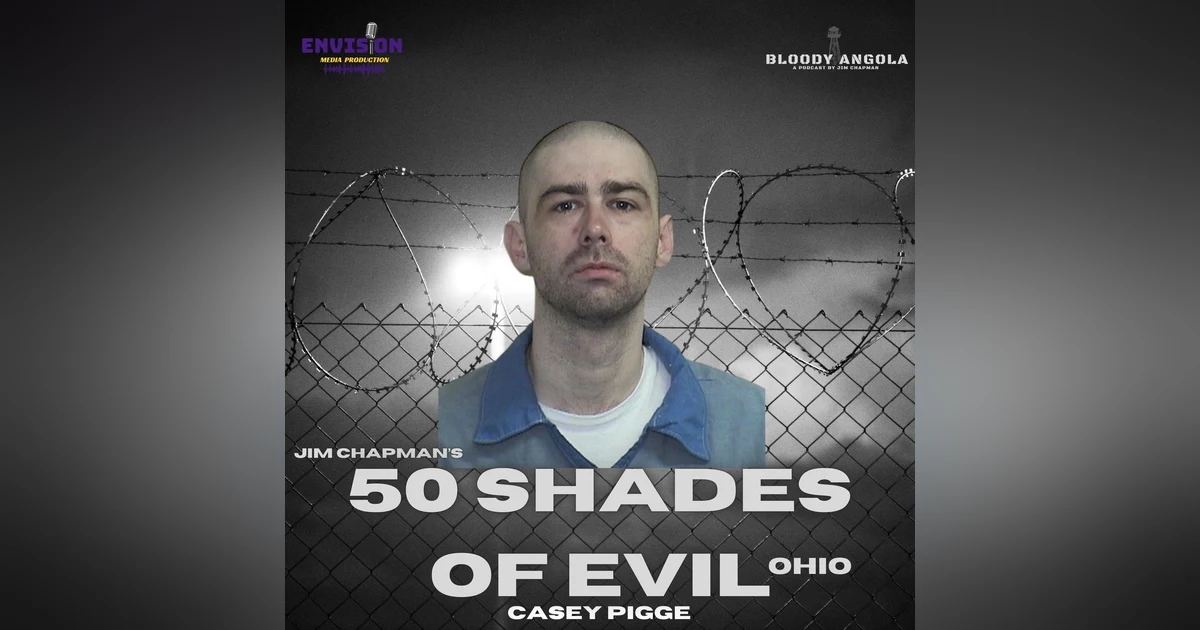
50 Shades of Evil: Ohio - Casey Pigge


 Apple Podcasts

 Castro

 RSS Feed
In 2008, a young man from Chillicothe, Ohio, slit his girlfriend’s mother’s throat, sat on the couch, and watched her die—then set the apartment on fire. He called himself “Box Cutter.” Prosecutors wanted death. A psychologist’s finding about his IQ took it off the table. He went to prison for life. That should have been the end of the story. It wasn’t.
In February 2016, Casey Pigge carved a cinder block out of his cell wall at Lebanon Correctional Institution, talked his cellmate into a “card trick,” and beat Luther Wade to death. He later said he wanted a cell to himself. Officials still put him on a prison bus. Two days after he pleaded guilty to that killing, he sat in the back of a transport vehicle with no cameras and no line of sight to the officers up front. Using a restraint chain, he strangled and smothered 61-year-old inmate David Johnson while other prisoners watched. When it was over, Pigge boasted: “I guess you never seen that on a bus before.” A year later, in another February, he and another lifer used homemade shanks to stab a Lucasville correction officer 32 times. The officer lived. Pigge did not stop talking about killing again.
For Louisiana Local Advertising inquiries or to book appearances please email BloodyAngola@gmail.com
0:15 I walk a straight line, shackled chain. Old Goose and Gertie is calling my name. There is no mercy in this penitentiary. Just ask the hill string gang, a wrangle of three. To die inside these walls inside the. Wild and when the wolf cries.
1:30 Hey everyone, welcome back to Bloody Angola. I am back with another Fifty Shades of Evil series episode. And today we're going to Ohio and I'm going to tell you about the crime and conviction and sentence of Casey Piggy. And to start this one off, I want you to keep in mind three separate Februaries. But here's what the records show. February 23rd of 2016, Lebanon Correctional Institution. This is in Warren County, Ohio, and a 26-year-old inmate named Luther Wade is beaten to death inside of a segregation cell. The weapon is a cinder block, and his cellmate carved the mortar out of the wall, pulled the block free, and used it. Prosecutors later compared it to something out of Shawshank Redemption. February 1st, 2017, a prison transport van, 15 inmates, three officers. David L. Johnson, who was 61 years old, is strangled with his own restraint chain. The officers driving that bus don't realize he's dead until they make a scheduled stop. And the man who did it later tells the other inmates, quote, I guess you've never seen that on a bus before. February 20th, 2018, Southern Ohio Correctional Facility. This is in Lucasville. Correctional Officer Matthew Mathias is stabbed 32 times with a homemade knife made
3:01 from pieces of metal bed frames. He survives, but barely. And that attack happened in the infirmary area Two inmates, and one of them is the same man from the two Februaries I just told you about. And that man was already in prison for murder. His name? Casey L. Piggy. Although he has been called a lot of things over the years. Hannibal Lecter. the worst cellmate, and Ohio's most evil prison serial killer. Now, those phrases may sell books or they may promote podcasts, but they also flatten a little of how evil this guy really is. Today, I'm going to tell you the real facts of what he did both inside and outside, so let's get into it.
3:49 Casey Piggy was born on January 9th of 1988. This is in Chillicothe, Ohio. His mother was just 14 years old. And that fact sits at the top of nearly every official document that I've looked at. The 2009 forensic evaluation, the sentencing hearing, the pre-sentencing reports. It's not a detail anyone tried to hide. It's the fact the system worked. recorded about him and his mother. Now, these same records say she used drugs and alcohol while she was pregnant with him. How much? How often? What types of drugs? I don't know that, but what I do know is that child protection authorities were already involved when Casey was just seven days old. Seven days old, y'all. Most newborns are still in the hospital or maybe just getting home.
4:44 Casey Piggy he already had his own case file. As a matter of fact the first three years of his life he didn't even live with his mother. He lived with his grandmother. He was told that his mother did not want to live with him. Now whether If that was really told to him or something he made up later on, we don't know. But what we do know is the living arrangement was real. Grandmother's house. Mother nowhere to be seen. Mother elsewhere, right? However, at three years old, that did change. He did go to live with his mother and the man that she was living with. What followed, according to people who later testified under oath, And according to what Casey himself told a Dr. Dennis Eshbaugh, in 2009 was a pattern the sentencing judge would call among the worst he had seen in 16 years on the bench.
5:37 They were homeless for a stretch. When they did have a place, Casey was often locked in the bedroom. Food slid to him underneath the door. He urinated into a heating register because he would not be let out of his room. That's what this young kid was dealing with. He was beaten. His aunt, Chassidy Brown, testified that later her sister, Casey's mother, always smacked him upside the head. She said Casey could not say anything back. She'd flip out and go crazy. And that lady also testified she once saw her sister, push Casey out of a moving car.
6:18 And there are other details in that same record. Cigarette burns when he was a toddler. Alcohol put in a baby bottle to knock him out, according to his aunt. Humiliation in front of other children, including on at least one occasion being made to strip in front of them. The mother did not make sure he went to school either. She didn't make sure he took mental health medication. He was prescribed. She just was not a active mother in any way, shape, or form. Now, Chassidy Brown told the court she called police or child services on some occasions, but she said she didn't feel like she was being heard, so she didn't call them on other occasions. Now, Casey was in and out of foster care throughout childhood. More than 100 placements. He was removed from home, and he was returned from home. He was removed again. returned again, just a continued pattern. And by the time he was eight years old, he had already been seen for what clinicians would call severe conduct disorder. He spent about two years in a treatment center, and that is a long stay for a child his age. It means the problems weren't a bad week or a single incident of acting out.
7:31 They were persistent enough that someone decided he he needed to live inside a facility. Now, the behavior list from those years that you see in a lot of later evaluations done on Casey are ones you would see with a lot of violent offenders. He would hurt animals. He set fires, at least one at his grandmother's house. He put a knife to his younger brother's throat, and he stole food from a neighbor. Now, at 11, he was seen for emotional instability and suicidal threats. At 15, again for threatening suicide, and he received outpatient mental health services at various points. He was diagnosed at different times during his childhood with ADHD and bipolar disorder. Later, Adult evaluations would add antisocial personality disorder. major depressive disorder, and anxiety.
8:24 And I want to give you one more piece from that same time frame in his history. There are indications in the file that he was abused by people other than his mother, including, according to the evaluation, while he was at a privately operated boot camp for troubled children. That was when he was 13. Now, that record doesn't give a full public accounting of what happened, but it does flag that that happened. That something happened of that sort happened. And that's how those files often work. They note something happened, but they don't always attach a police report to the public that they can read because he is a minor. And I want to be careful here with these facts I'm giving you. And I don't want you to think in any way, shape or form that I am justifying anything he did, because that's absolutely not what I'm going to do. Yes, he had a horrible childhood.
9:18 But that doesn't make it so these murders feel smaller or that they should have been committed. They should not have been committed. But it's important to know what this kid went through as a kid. It certainly doesn't change the fact of these victims. Rhonda Summers is still dead. Luther Wade is still dead. David Johnson is still dead. and Officer Mathias still carry injuries from 32 stab wounds that we're going to get into. I'm bringing all this up because it's documented and it's a starting point. When the state of Ohio later had to decide whether Casey Piggy was eligible for the death penalty, this happened. history, that came into play and that's what the psychologist used.
10:04 When the judge sentenced him, this is the history that his aunt put on record. When prison officials later had to explain how a man already serving decades kept finding ways to kill people in custody, this is the history that They already had on file, so it was important that I give that to you. Now, it's worth noting that Judge William Corzine, who sentenced Casey for a 2008 murder, he condemned the abuse like we all would. He said it was no excuse, though, which most of us would agree to. Both of these statements can be true at the same time, y'all. The abuse was real, but in no way justifies what would come next. There's also another detail from a 2009 evaluation that matters for everything that follows. Dr.
10:52 Eshball noted that despite everything his mother had done, Casey remained highly dependent on her. And that is not unusual in cases of severe childhood mistreatment. The person who hurt you is also the person you are most attached to. A child can be locked in a room and still organize his inner life around a person who locked the door. Think about that. That attachment will show up again when we get into the teenage years with Casey and the relationship with a girl named Angelique. It will show up in the reason Casey later gave for going to Rhonda Summers' apartment, but I'm not there yet. Now, where he was from, Chillicothe, this is not a huge city. People notice things. Teachers notice when a kid's not in school.
11:40 Neighbors notice when a child is locked in a room. Some of them called. Some of them did not call that noticed these things going on with this kid. And the official system opened a file, as I told you, at just seven days old and then spent the next 18 years moving him in and out of the same system. As a matter of fact, 100 placements he had, and that's not a sign of a system that did not know there was a problem. It's a sign of a system that kept trying the same solution, sending him home, pulling him out, sending him back home after the problem had already been identified. By the time Casey was old enough to pick up a criminal charge of his own, the childhood file was already thick. But regardless of that, it doesn't tell you he was going to kill somebody.
12:30 As a matter of fact, most children, the vast majority who survived that kind of start do not kill people, but they are warning signs. So let's go to June of 2006 in Ross County, Ohio. Casey is 18 years old and he gets charged with breaking into entering and receiving stolen property, which was a golf cart. He pleaded guilty to that. Now, this was his first real kind of stint in jail. The first time he saw the locked door was not his bedroom in his mother's house or foster placement or treatment center. It was a cell with his name on a booking sheet. Then two weeks into a new relationship, he was arrested again. And that timing matters because of who that relationship was with in this story. And her name was Angelique. And she has spoken about him in later interviews. She was 16 when they met and he was 18. She said they met through a friend and she thought he was nice, very sweet.
13:31 He would come to her work with flowers and she said she never had a boyfriend like that. And she wanted to be around Casey all the time. She was young love, right? So he actually went to jail on that golf cart case almost immediately after they started seeing each other. And when he got out, They stayed together. In February of 2008, as a matter of fact, a daughter was born to them, and they moved into a place of their own, a few doors down from Angelique's mother, Rhonda Summers, in Chillicothe. Now, on paper, it looks like the first attempt at kind of a family unit for Casey Piggy that he had ever had. This was not a placement. It was not a locked room. He had a girlfriend. He had a baby. He had an apartment near the grandmother's. and the mother of Angelique. And Angelique said she felt hopeful that this was going to be the love story of all time, right? The psychologist who evaluated Casey a year later would look at the same stretch, but he would use a different language.
14:32 Dr. Dennis Eshball told the court that Angelique and the baby appeared to be Casey's primary source of self-esteem and security. And remember what Ashbaugh had already said about Casey's mother. Despite everything she had done to him, Casey remained highly dependent on her. Now there's a new attachment, a 16-year-old girl and an infant. And this person who had spent his childhood locked away from care had found two people he could organize himself around. But that's not a romantic observation. It's a clinical one. It becomes important the moment that relationship becomes threatened. And by the summer of 2008, the tension in that relationship was at a very high level.
15:19 Rhonda Summers, Angelique's mom, was not a distant figure from them. She only lived a few doors away. She was in her daughter's life. She was in her granddaughter's life. And according to the prosecutors later, the day before the murder, Rhonda was at the hospital with Angelique and that baby because of an injury that the child had sustained while Casey... was the only adult in the room. So they get back from the hospital, they all go about their business, and the next day, Casey Piggy goes over to Rhonda Summers' apartment. Now, what happened inside that apartment comes from three places that largely agree with each other. The physical evidence, Casey's own statements to detectives, and the prosecutor's comments at sentencing.
16:05 And we're going to stay with those. We're not going to add any scenes where there's no proof that exists. What we know for a fact is he used a box cutter. He cut her throat at least five times, and the wounds were later described in court as lacerations of about eight inches. They severed the carteroid artery and the jugular veins. Then, Casey sat on the couch and watched Rhonda Summers, the mother of his girlfriend, die. As a matter of fact, he didn't leave the room even when she was still alive after those cuts. He just stayed right there. And after she was dead, he went upstairs.
16:46 He washed the blood off himself. He came back down. He took some money. Then he left and set the apartment on fire. When detectives asked him why he started the fire, he said, quote, I had to let everybody know. He also told him this. That was the scariest thing I've ever seen. I can still smell her on my hands, her blood. I can smell it on my hands. And those are his words, y'all. Not a screenwriter's, not mine. He said them after he had already been caught. He gave investigators another explanation as well. He said people told him he had two sides to himself. And he said when the bad side kicked in. He didn't remember much.
17:29 He would get so mad, he said, that he would black out. And before the blackout, he would start crying. And he said this is what happened when he attacked Rhonda Summers. Then the fire, he said, well, that brings eyes on the crime to the rest of the street, right? firefighters and police arrived. They're thinking they're dealing with an apartment fire. That's what it looked like from the outside. But when they went through the scene, they found Rhonda Summers' body behind a couch in the living room. Her throat had been cut. And they knew right then, this isn't a fire that was started by accident. It's someone who killed somebody and then set a fire, and this was a homicide. Angelique, the daughter, had described what the afternoon was like from her side of West 2nd Street.
18:16 She learned that her mother's apartment was on fire and that they could not find her mother, so she ran to the house. She said she did not stop, and by the time she got there, the fire was out, and they still had not found her mother. Then they told her they had found the body. She said she immediately knew it had to have been Casey that did it. Now, Casey was not there when they found the body. He had already left. He asked a stranger for a ride and he went to his cousin's house and officers found him about six hours after that fire. He had a spot of blood on his shorts. He still had the box cutter on him and the blood on his shorts was described as a mix of his blood, and that of Rhonda Summers, and he was arrested that same day.
19:03 So at 20 years old, Casey Piggy. was in Ross County Jail for aggravated murder. Now, the nickname he later used for himself came from that crime, Boxcutter. That was his nickname. He did not get that name from a newspaper. He actually gave that name to himself after the fact. It's a small detail, but a revealing one. He actually attached an identity to what he had done in that apartment. He wasn't even sad about it. Now, I want to talk about Rhonda Summers quickly as a person and not as a crime scene. The public file doesn't give a full biography of who she was, but what it does give us is the people who stood up in court a year later and told a judge what had been taken from them. Her husband, Antonio Summers, her son, Jacob Hawk, her sister, Becky Ramsey. They spoke at the sentencing about the depth of that loss. They asked for a sentence that would keep Casey Piggy locked up for the rest of his life. They weren't talking about a stranger who had wandered into an apartment here. This was someone that knew the mother, the wife, the sister, the grandmother who lived just a few doors down from this animal. So what was the motive here? Well, Rhonda, in Casey's account, was interfering with his relationship with Angelique and his access to the baby. She was the adult who could separate him from the only people who gave him a sense
20:34 of being wanted. He had a plan to take Angelique and the child to Texas. As I told you in Go Kill His Own Mother, Dr. Ashberg would later opine that Casey decided to kill Rhonda because she had threatened his source of self-esteem and security. And there are elements to this killing that were planned and elements he later tried to describe as a blackout. And that's important. The fire is hard to fit into a blackout, y'all. Washing the blood off, hard to fill into a blackout. Taking money, hard to fit into a blackout. Leaving and hitching a ride to his cousin's house, kind of hard to fit into a blackout. Those are steps you took after you created this mess, after you committed this crime. This happened after Rhonda Summers was already dying or dead. The box cutter itself, that's a choice. It's not a weapon you happen to pick up in the sudden, you know, throes of an argument or a fight in a kitchen. He had brought that box cutter and he used it repeatedly.
21:38 He stayed to watch after he sliced her throat five times. Casey Piggy, plain and simple, killed Rhonda Summers in her home. and he did it in a way that was intimate and prolonged. He then tried to burn the evidence and announce the act at the same time, and he was caught that same day because he still had blood on him and the weapon in his possession. All that physical evidence, I don't care what he says about a blackout, all of that other stuff that he did, it doesn't line up with his account, if you will, of events. Now, the legal system's first response was the one you would expect in Ohio in 2008 for a slashing homicide followed by an arson. He gets indicted on an aggravated murder charge with death penalty specifications, plus aggravated robbery, aggravated burglary, aggravated arson, tampering with evidence, and other related charges. And for a short window, the state of Ohio... was preparing to ask a jury to put him on death row.
22:42 So while he waited for trial in the Ross County Jail, Casey added new charges to that pile that he was already stacked with. He was caught digging the caulking out of his cell window and putting toothpaste in its place. Now, prosecutors treated it as the start of an escape attempt. He was also found with a homemade knife. Those jail charges, escape and possessing a deadly weapon under detention, would travel with him into the plea, even before he had been sentenced for killing Rhonda Summers. the jail staff was already documenting that he would work on a window and keep a weapon. So on August 25th of 2009, at a pretrial hearing, the state asked the court to waive the death penalty. The reason was not a change of heart, if you will, about the crime. The reason was an evaluation. Again, psychologist named Dennis Eshball was brought up and he had spent hours with Casey. He had reviewed the child welfare history we've already walked through. He looked at school records, treatment center stays. and diagnoses throughout the life of Casey Piggy.
23:51 And his conclusion was the one that kind of changed the legal ceiling of this case. He found that Casey Piggy met the standard for intellectual disability, what the courts at the time still often call mental retardation. reporting on the evaluation had put his IQ in the mid to high 60s. A few points under the line that after the United States Supreme Court decision, Atkins versus Virginia in 2002 generally would take a defendant out of eligibility for execution. Now, that finding wasn't a defense trick. It actually came from the state's own expert. Under Atkins, the Constitution does not allow for the execution of a person with an intellectual disability.
24:36 Ohio's prosecutors could believe every word of the indictment and still be barred from asking the jury for death. So they dropped the death penalty charge they were seeking. And once death was off the table, the incentive to go to trial changed. Casey had been looking for a possibility of a death-qualified jury, and now the maximum was life. And as you would expect, plea negotiations would follow soon. And in November of 2009, Casey pleaded guilty. Now, the plea covered the aggravated murder of Rhonda Summers, the aggravated robbery, aggravated arson, tampering with evidence, and the jail charges from that window and homemade knife that they found. He also stood in front of the judge and admitted the facts of the case the state had laid out. The box cutter, five cuts, time on the couch. in the fire. Then the sentencing phase occurred. And of course, you're going to have victim impact statements. Chasity Brown, Casey's aunt, testified about the abuse, the beating, the lock room, the crack smoking while a child was shut away in another room, the alcohol in the baby bottle, the push from the moving car.
25:52 She told the court she had called police or child services all the time on this situation until she finally gave up. and that she would have tried anything in the world to take him when he was younger. Dr. Eshball testified from the evaluation, the intellectual disability, the stack of other things that he had diagnosed throughout Casey's life, ADHD and bipolar disorder, anxiety, those things. And he offered his view of the motive, saying Angelique and the baby were Casey's primary source of self-esteem, and that he felt threatened by this lady. Antonio Summers, Jacob Hawke, Becky Ramsey, they described what had been taken from them, and they asked the judge for life without parole. They were not required to be clinical. They were only required to tell the court what the loss meant. And that's exactly what they did. Now, prosecutor Michael Ader, he asked for the hardest sentence the plea in the law would allow. He wanted a life without parole. He told the judge Casey had learned to use his childhood as both a sword and a shield, something to strike with and something to hide behind. He also said when investigators first questioned Casey about the murder, Casey wanted to talk about his childhood.
27:08 The prosecutor's point in this was not that the childhood was invented. It was a case. He already knew how to put that in front of the crime. And then Casey spoke briefly. He said, I never meant to hurt anybody. I'm sorry. I know this doesn't bring her back, but I've never meant to hurt anybody. Now that's a statement on the record. It's short. And it's the kind of language judge hear a lot in courtrooms. The judge then condemned the abuse, said it was the worst he'd ever seen in 16 years on the bench. But he also brought up the point, it's not an excuse for killing someone. And then he made his ruling. He did not give the state a straight life without parole sentence on the murder count. He sentenced Casey to 30 years to life for the aggravated murder of Rhonda Summers. He then stacked other time on top of it, six years for aggravated robbery.
27:59 two years for the escape charge, three years for possessing a deadly weapon, and those consecutive pieces are how the total became 41 years to life. The arson and tampering counts were run in a way that did not add much to the front end. Credit for time served since the arrest, of course, he got, and that came off at the top. So after all was said and done, he was satisfied Casey would serve at least 40 years before being eligible for parole. So in November of 2009, Casey Piggy is a convicted killer at just 21 years old, and he's sentenced to 41 years to life. And he's eventually sent to Ohio State Penitentiary. This is in Youngstown, which exists for inmates whose behavior in the department's own language is is too dangerous for a regular maximum security yard.
28:52 And notice I said Casey would eventually get there. Eventually, because he would go there after three more attacks, not before them. For the first several years, he actually lived in the ordinary flow of the system, including time in general population, which means he had a cellmate, and his misconduct record would grow. By the time of the first in-custody killing that he committed... The record he had built in prison ran about 30 pages. Everything from refusing to lock in, making alcohol inside a prison, contraband, razor blades, electrical cords, a television converter box, fights. But none of those entries is a murder. Together, they're the map of a man who was already treating rules. even in prison, as optional in the cell that he lived in as a workshop. So let's go to February 23rd of 2016.
29:48 Lebanon Correctional Institution, which is about 30 miles north of Cincinnati, Ohio. Casey was 28. His cellmate was Luther Wade, 26, from Springfield, Ohio. And what happened in that cell was described by a Warren County prosecutor in language that stuck. Casey carved the mortar out of the wall, pulled a cinder block free, and beat Luther Wade in the head with it, until he was dead. The prosecutor said it was something out of Shawshank Redemption. And there's another detail in the investigative file. Casey told authorities he tricked Wade into wearing a blindfold as part of a card game, then used the block. Now, you can't independently confirm all of that. The physical fact, though, you can confirm, and that was that a block came out of the wall and Luther Wade was beaten to death with it. Casey said after years of sharing space, he had decided he was done sharing it. And Luther Wade was dead for it. And Casey Piggy had killed a second person. So he gets charged with aggravated murder.
30:57 And because the victim was an inmate, the crime could have carried death. But it did not. That 2009 intellectual disability finding, it was still in that file of Casey Piggy's in the same constitutional rule that had blocked death for Rhonda Summers, blocked it for Luther Wade. So on January 30th of 2017, Casey pleads guilty to that murder. Coverage of the hearing noted that he was brought into court in a straight jacket. The judge added life without parole for the wave murder. And that sentence on its own should have been the end of any question about whether Casey Piggy would ever be released. It was not the end of the violence, though. Two days later, two days later, he's on a prison bus. February 1st of 2017.
31:48 He had just pleaded guilty to beating Luther Wade to death. The department put him on a transport van with other inmates for the trip back to Southern Ohio. David L. Johnson was on that bus. Johnson was 61 and he was serving an eight year sentence for sexual battery. Casey was in a belly chain and handcuffs. Now the other inmates later told investigators he worked the chain down his feet so he could move. And he used those chains to strangle David Johnson. The officers on the bus, and there were three of them, they did not know Johnson was dead until the bus made a scheduled stop to drop inmates at Ross Correctional Institution in Chillicothe. And this killing had happened in a vehicle full of people. with officers just a few feet away. And Casey bragged to the inmates who were still alive that this is the first time anyone has killed a person on a bus with his chains on. And the line that made it into almost every story since was, quote, I guess you've never seen that on a bus before. Highway Patrol actually had to stop the bus to take his clothes and chains in as evidence. And he was charged again, obviously, Pickaway County this time because of where the body was discovered.
33:09 And on September 27th, 2017, he pleaded guilty to that. Judge Randall Neese sentenced him to 25 years to life, consecutive to everything he was already serving. And this is really a symbolic sentence. You're already never getting out. The prosecutor on that case said she knew that she could not really increase a life sentence, but David Johnson was still a victim and deserved justice. Now, coverage of that plea hearing noted that Casey half chuckled when the judge asked if anyone had threatened him into pleading guilty. He said no. He was wearing the same kind of black lockbox, y'all, and chains that he'd been wearing when he killed Johnson and a SWAT officer stood very close by. And after the Wade killing, a prison social worker would interview Casey.
34:02 And he denied that he wanted to be a serial killer in prison, which he had told a lot of inmates. But he also would not promise that social worker that he would not kill again. So on May 1st of 2017, after Wade, after Johnson, he wrote a letter to another inmate. He said it was a funny thing that he had killed both men in February. And then he said, truth be told, I'm going to get me another one. You'll see. So let's go to February 20th of 2018, Southern Ohio Correctional Facility in Lucasville. Now, this prison still carried the shadow of a 1993 riot. It was maximum security, and Casey was there with another inmate named Greg Reinke. Both men were already serving life sentences for aggravated murder. and they attacked a correctional officer named Matthew Mathias. The weapons they used were shanks made from pieces of metal taken from prison beds. Casey had made them. And the attack happened in the infirmary area. Mathias was stabbed 32 times, not counting defensive wounds. He would live, but he would have multiple surgeries afterward. And his life, as the prosecutor later told the judge, was permanently changed. Now, this was the first of the in-custody cases where Casey refused to talk to investigators the way he had talked about Summers, Wade, and Johnson. The explanation that later appeared in a letter
35:34 he wrote is smaller and really crueler than the grand theory of prison serial killing. He said the officer had gone into his cell and broken his CD player, and he said the officer was talking shit on a whole nother level and lying to him. And he said, that was why I attempted to kill this correctional officer. So he and Reinke, they both get charged. Casey pleads guilty in April of 2019 to aggravated murder and related counts. And the judge and prosecutor treated the two inmates as equally culpable. Casey received 32 additional years consecutive to the life sentences he already had. And when he was given a chance to speak, he showed no remorse. He told the court there had been this much drama when people were egging him on to kill inmates. So it is what it is. There's always two sides to a coin, he said. And after that stabbing, he was moved immediately to the Ohio State Penitentiary. And that is the transfer, really?
36:39 In hindsight, that should have happened after Luther Wade. So by the end of 2019, he was no longer a man with parole-eligible murder charge one. Only one killing, right? He was a man with life without parole, stacked on life without parole, stacked on decades more, living at the only prison Ohio used for inmates that cannot be managed anywhere else. And that's still where he is today. Ohio State Penitentiary in Youngstown is restrictive housing. The offender search still lists him as incarcerated there, and he will never be released from after what he has done. And he shouldn't be. Nobody should ever get him back. Luther Wade's family did not get him back. David Johnson's family did not get him back. Matthew Mathias has to live inside a body that was opened 32 times. Casey Piggy has a cell to himself now. He got it by turning the institutions that were supposed to hold him into locations for his next crime. Rhonda Summers, 52 years old, wife, mother, sister, grandmother, who lived just a few doors down from her daughter, killed her. Those are the people that we should care about.
38:01 Fuck this guy. And I gotta tell you, of all the episodes I've done with Fifty Shades of Evil thus far, Casey Piggy is certainly one of the most evil inmates I have covered yet. And definitely fitting For this series. So thank you so much for listening. Check out the Patreon for commercial-free early releases. Hey, it's football time. Kicks off this weekend. Have a happy Labor Day weekend. Be safe. If you're drinking, call an Uber or a Lyft or whatever. And if you're watching football, go LSU Tigers. Or whoever you pull for during football season. I sure am excited about it. I will talk to you next episode. I'm Jim Chapman, your host of Bloody Angola. Much love. I walk.
39:09 A straight line, shackled chain. is calling my name. There is no mercy in this penitentiary. Just a I'm here to die Inside these walls Inside the wild And when the world cries.